This post contains affiliate links. I may earn a small commission at no extra cost to you. Thank you for supporting Snowflakes & City Lights Travel.
There’s no Grab in Macau. No Uber either. If you’re coming straight from Hong Kong like we did, you’ll have spent five days getting anywhere you wanted in about four taps on an app, and getting around Macau doesn’t give you that option.
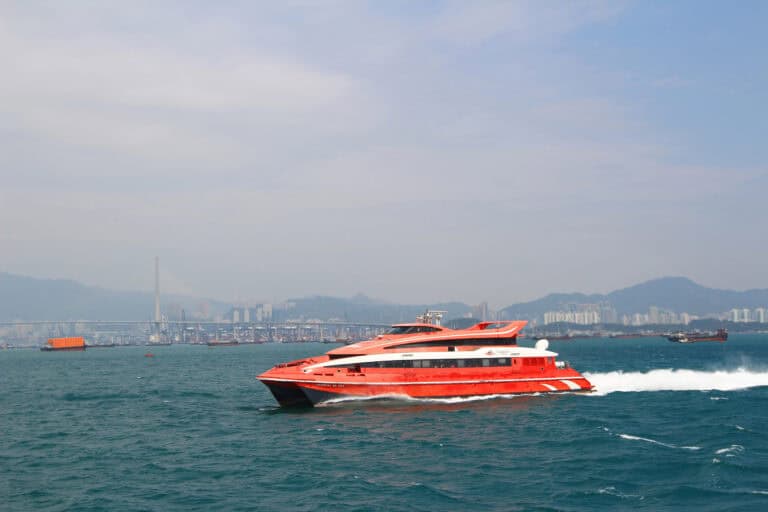
If you’re coming from Hong Kong, getting between the two is straightforward and we’ve broken down exactly how the ferry and bus options work and what do again here.
The good news is that buses are genuinely good. Cheap, air-conditioned, and they cover almost everywhere you’d want to go. The catch is that you really do need a Macau Pass to use them properly, and getting ours took the better part of a morning and an impressive amount of frustration. More on that shortly.
Here’s what you need to know before you arrive as a first-timer trying to get around Macau.
Quick Answer: Getting Around Macau
- Buses are your main transport
- Get a Macau Pass at the ferry terminal on arrival
- Don’t rely on taxis for anything time-sensitive
- Most of the historic centre is walkable
Buses
Public buses are by far the best way to get around Macau. They are cheap, air-conditioned, frequent and cover almost everywhere you’d want to go.
The fare is MOP 6 per trip if you pay cash. They accept exact change only with no exceptions and no change given, meaning you need to have small change on you ready to go. You drop the coins into the box by the driver as you board at the front of the bus. You exit at the back. With a Macau Pass the fare drops to MOP 3, which combined with not needing to carry coins, is the main reason to get one.
One useful note for families travelling with younger kids: children under one metre in height ride buses free when accompanied by an adult. This is set out in Macau’s official bus fare order and applies on standard routes, express routes, and the LRT. Our son was well over the height limit so it did not apply to us, but if you are travelling with a toddler or a smaller child, it is a handy hint to know. We didn’t see anything that would have highlighted this while there in person.
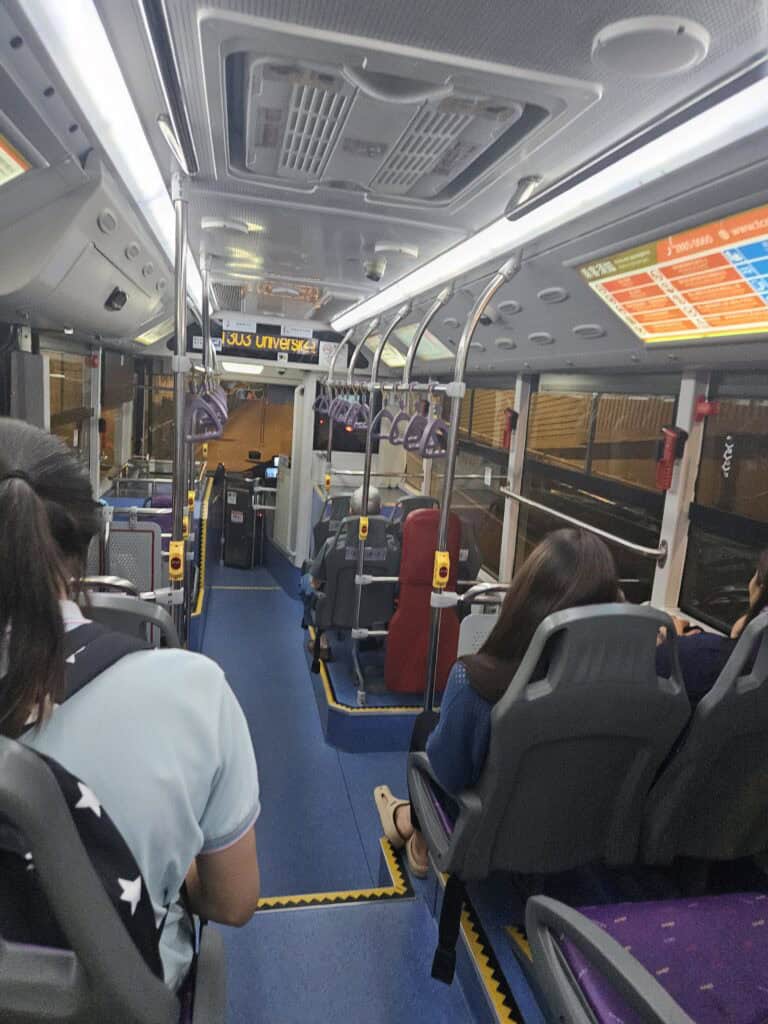
Some buses now accept Alipay and WeChat Pay via QR code at the full MOP 6 fare. Both apps can be set up by foreigners using an international bank card, but neither is a quick process and you’d need to have it sorted before you leave home rather than trying to do it on arrival.
If you’re not already using these apps and want to try them out, you’ll need to set this up before you leave. Wise have a really clear guide on how to set up Alipay with a Wise card here, and also a guide on setting up WeChat with a Wise card.

To work out which bus to take, we found the best way for us was to put our destination into Google Maps and it’ll give you the route number. Then look for that number on the sign at the stop. The signs list a grid of numbers, sometimes ten or more at a single stop, which looks chaotic at first. Google Maps makes it manageable.
For live bus arrival times at the stop, the transport bureau’s DSAT app is the most reliable option. If you want something broader that also covers walking routes and the LRT, Macao Smart Go is the newer alternative. Worth downloading one before you leave. We had it, but actually found Maps better for us.
You’ll need data for this, especially if you’re relying on Google Maps at bus stops. We use an eSIM like Airalo so we’re connected as soon as we arrive, without dealing with physical SIM cards or airport kiosks.
We used buses for most of our trips. Out to the Giant Panda Pavilion, across to Coloane, back from Taipa Village to the peninsula. Once you get into the swing of things, they are a great way to get around.
If you’re heading out to Cotai, a lot of the attractions there can be pre-booked online which is useful if you’re trying to avoid queues or plan your time more tightly.
The downside is that they can be slower than you expect. Some of the routes take much longer than driving. For example, we travelled from the Peninsula area to the Giant Panda Pavilion in Coloane. It’s roughly a 15 minute car ride, though it took an hour by bus. On the Friday afternoon we were trying to get back toward the hotel, traffic stretched what should have been a short trip considerably. Don’t plan bus connections tightly if you need to be somewhere at a specific time.
The Macau Pass
The Macau Pass is Macau’s equivalent of an Octopus card. It works on buses and the Light Rail Transit, and you can use it at convenience stores and vending machines around the city too, so any unspent balance doesn’t go to waste.
The card costs MOP 130: a MOP 30 non-refundable service fee and MOP 100 of stored value. You can top up in cash at 7-Eleven or most supermarkets and the minimum top-up is MOP 50.
Get it at the terminal when you arrive. Don’t wait. There are vending machines at Macao Port (the Outer Harbour Ferry Terminal – if you haven’t sorted your ferry yet, here’s how we got from Hong Kong to Macau), usually near the arrival hall exits and they take MOP cash banknotes, so hit the ATM at the terminal first if you need to. The standard green card is also available at 7-Eleven, Circle K, and Royal and Sunsco supermarkets throughout the city, but the terminal is the easiest option before you need it.
The reason that matters is that convenience stores don’t always have the standard card in stock. When we arrived there was a major NBA event on at the casinos, and every 7-Eleven near us had replaced their standard stock with a promotional NBA keyring version that cost significantly more (particularly when buying one for each family member).
We spent the better part of a morning trying to find a standard card. Another 7-Eleven, a supermarket with the same NBA card bundled with a basketball headband at an even higher price, a failed attempt to set up the digital pass through the app (not possible for tourists as it requires a local bank account to verify), and eventually went back and bought the overpriced keyring card anyway. After yet another trip to find an ATM to pay for it in cash…we now own a very specific Macau souvenir.
Having said that, they do have some great promotional Macau cards and items (like little plushies and keyrings) that pop up. I’m not a basketball fan so this one didn’t do much for me, but having looked online at some of the past options I probably wouldn’t have thought twice about the extra cost for some of them. I particularly liked the little egg tart plushie pass!
Anyway, had we picked one up at the ferry terminal on the way in, none of that would have happened and we would have saved about 2 hours of our day, which is not a small amount of time on a 2 night trip.
Top-ups are cash only, so make sure you have MOP on hand before you need to reload. Taxis are also cash only, and we ended up needing more cash across our two days than we expected. This is where a card like Wise earns its keep. You can withdraw cash overseas without the usual fees adding up.
The Light Rail (LRT)
The LRT runs through Taipa and connects the Taipa Ferry Terminal, the airport, and the Cotai casino strip, with Barra Station providing one connecting point at the southern end of the Peninsula. Fares start at MOP 6 and cap at MOP 12 depending on distance. Pay with your Macau Pass for a discount. It doesn’t currently serve the historic centre of the peninsula, so if you’re based near Senado Square it won’t be your first port of call.
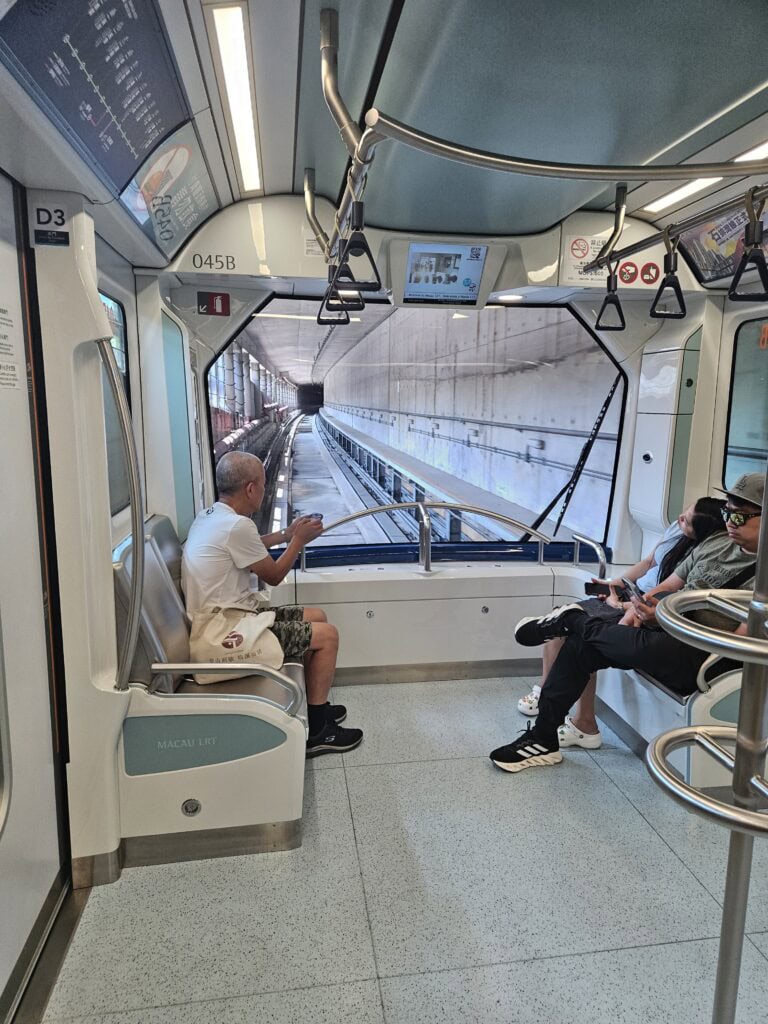
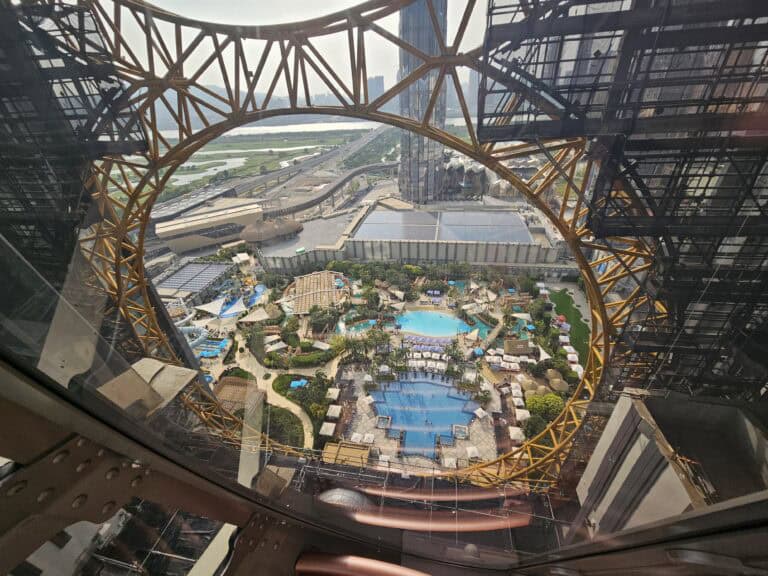
We used it once, taking it out to the Cotai strip. It was quiet, with hardly anyone on it and the views over the bridge between the two islands were genuinely worth it. The catch was the arrival end. We stepped off and found ourselves on what felt like a service road (Cotai West Station), a long walk around to the front of the casinos. It’s possible we got off at the wrong stop, but it didn’t feel set up for tourists heading to the strip. Factor in some extra time to find your bearings when you get off, and check Google Maps before you board so you know which stop to aim for.
We wouldn’t go out of our way to use it again but if you’re arriving via the Taipa Ferry Terminal or heading to the airport, it’s the most direct option.
Taxis
Taxis are metered and cash only. The reason taxis aren’t a great go-to plan is that Macau runs a government-regulated fleet, with a limited number of taxis available.
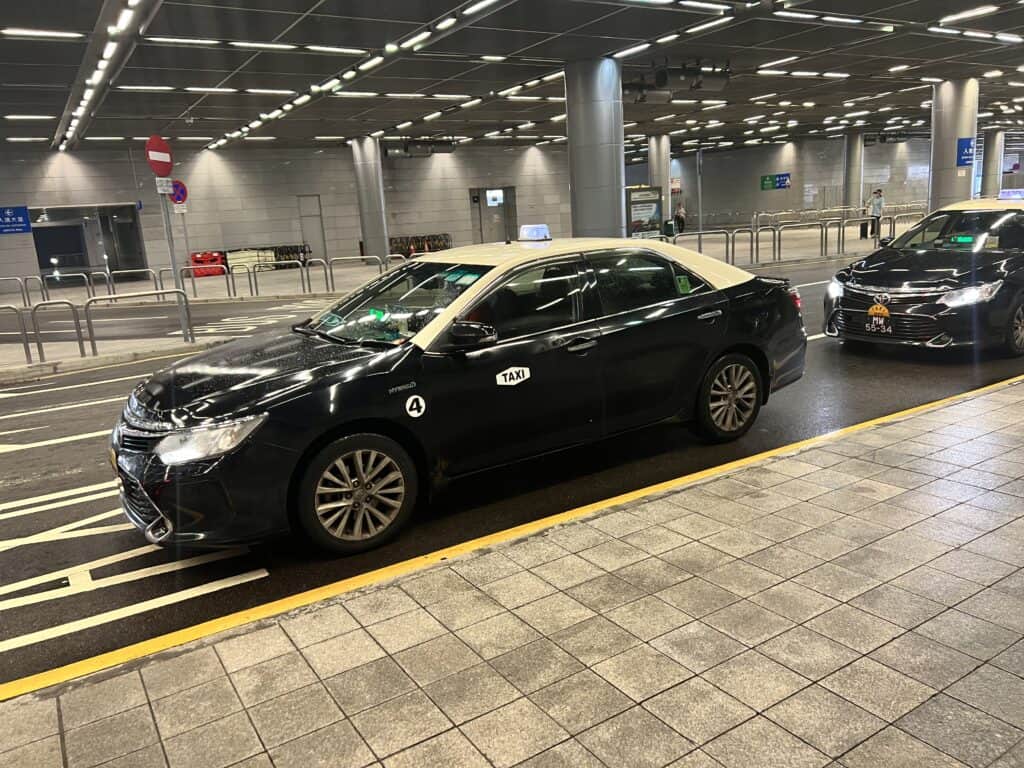
During peak times such as weekends, public holidays and Friday afternoons, taxis are genuinely scarce. When we needed one on our last evening to reach the ferry terminal, the hotel couldn’t get one for us and we couldn’t flag one down on the main street. We loaded the luggage onto a bus, headed somewhere busier, and eventually flagged one down from the street. It worked, but it was purely down to luck. We were actively looking for an alternative bus route when my husband flagged one down on the other side of the busy intersection.
We did catch two other taxis while in Macau and found that heading to a hotel or casino foyer was an easy and reliable way to find one.
Flag fall is MOP 21 for the first 1,600 metres, then MOP 2 per 220 metres. Some small surcharges apply at the airport and Taipa Ferry Terminal, and for trips to Coloane. Luggage in the boot costs MOP 3 per item.
Grab doesn’t operate in Macau, and until recently neither did Uber. However, as of February 2026 Uber has relaunched, though not in its traditional form. It now allows you to hail local taxis and pay by card through the app. Availability is still limited at peak times, but it’s a handy option outside of peak hours when availability is more reliable.
Walking
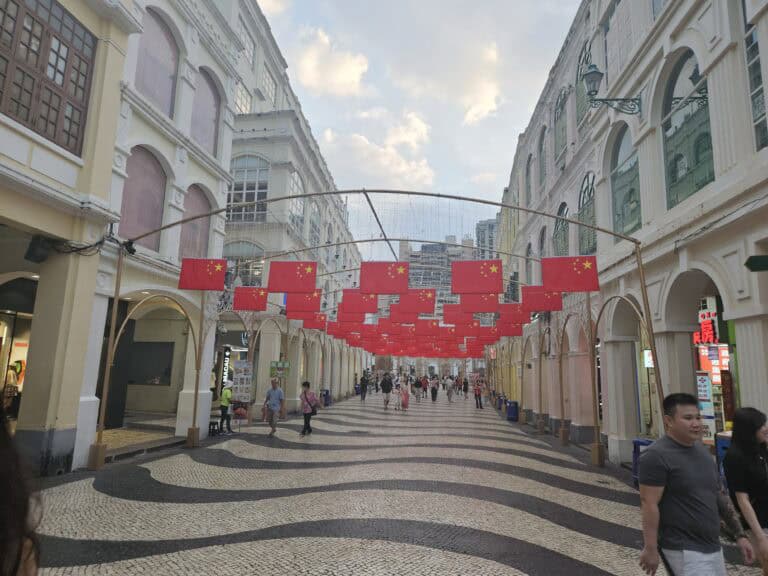
If you’re staying near the historic centre, which is where we’d recommend, the main peninsula sights are all on foot. If you’re still deciding where to base yourself, here’s how the different areas in Macau compare and what that means for getting around. Senado Square, the Ruins of St Paul’s, Monte do Forte and the streets around them are walkable from a central hotel, and that’s the best way to see them. Across our two days we spent a lot of time on foot in this area without needing any transport, which ended up being the best way to see the city.
The humidity is the catch. In October it made the short walks feel longer than they looked on a map, and what seems like a short walk can turn into a slow, sweaty detour if you’re not used to it. Plan walking for mornings and build in time to cool down.
To reach Taipa, Cotai, or Coloane you’ll need a bus regardless of where you’re staying.
Quick reference
|
Transport |
Best For |
Cost |
Macau Pass |
Notes |
|
Public Bus |
Most trips – Taipa, Cotai, Coloane, Peninsula routes |
MOP 3 (MPass) / MOP 6 (cash) |
Yes |
Main way to get around |
|
LRT |
Taipa Ferry Terminal, airport, Cotai strip |
MOP 6-12 (MPass discounted) |
Yes |
Good views, connects locations in Taipa and Cotai |
|
Taxi |
Late nights, luggage, rain, out of peak hours |
MOP 21 flag fall + meter |
No (cash) / App (Uber) |
Hard to find at peak times |
|
Walking |
Historic centre, peninsula sights |
Free |
N/A |
Best for the main sites |
|
Casino shuttles |
Between casino resorts |
Free (not only for guests) |
N/A |
Can’t use for general transport |
Before you go
Get the Macau Pass at the terminal when you arrive. Download Google Maps offline for Macau before you leave. Have MOP cash on hand for top-ups and street-hailed taxis. And if you’re staying near the historic centre, you’ll use the buses less than you think. Most of the peninsula sights are on foot.
If you’re still working out where to stay, where to stay in Macau covers the location trade-offs in detail.
If you’re planning activities or want to pre-book anything in Macau, platforms like Klook and GetYourGuide are usually the easiest way to do it. They’re particularly useful for things like Cotai attractions, observation decks, or bundled tickets if you’re short on time and want to avoid queues.
If you’re using Maps to get around (which you will), having data from the moment you arrive makes everything easier.
If you’re linking Macau with Hong Kong or Hanoi, this is the exact route we used and how we made it work without wasting travel days. If you’re still in planning mode, this is how I approach building multi-city trips that flow.